What could the recycling/waste industry do with $2.7B per year in investment?
By: Mike Ritchie, MRA Consulting Group
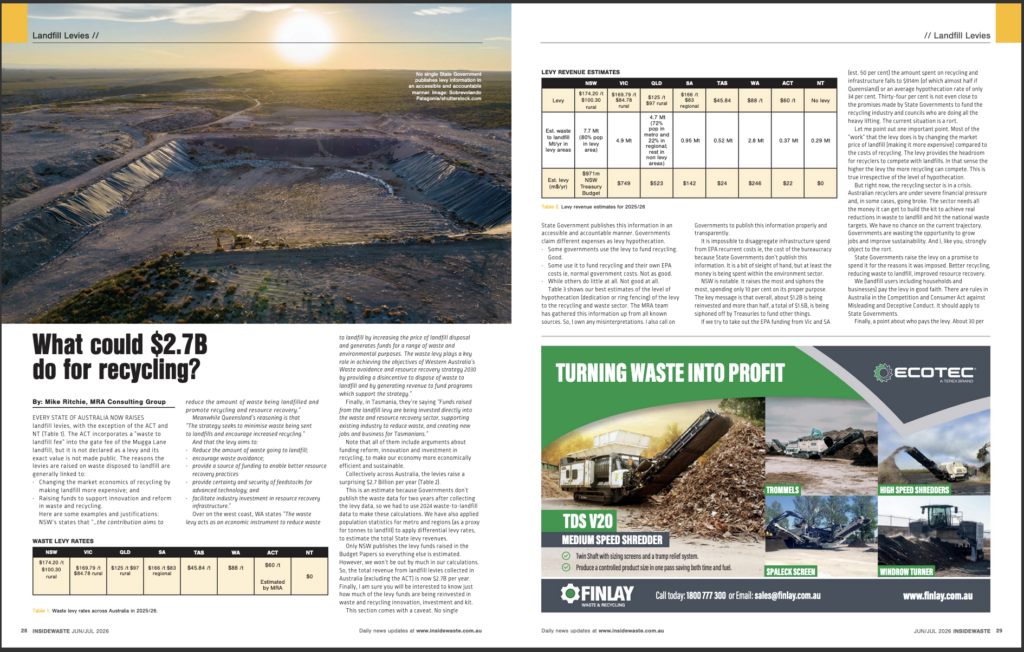
Every State of Australia now raises landfill levies, with the exception of the ACT and NT (Table 1).
(The ACT incorporates a “waste to landfill fee” into the gate fee of the Mugga Lane landfill, but it is not declared as a levy and its exact value is not made public).
Table 1 Waste levy rates across Australia in 2025/26
| NSW | VIC | QLD | SA | TAS | WA | ACT | NT |
| $174.20 /t$100.30 rural NSW Levy Rates | $169.79 /t$84.78 rural VIC Levy Rates | $125 /t $97 rural QLD Levy Rates | $166 /t $83 regional SA Levy Rates | $45.84 /t Tas Levy rates | $88 /t WA Levy Rates | $60 /t Estimated by MRA | $0 |
The reasons the levies are raised on waste disposed to landfill are generally linked to:
- Changing the market economics of recycling by making landfill more expensive; and
- Raising funds to support innovation and reform in waste and recycling.
Here are some examples and justifications:
NSW – “…the contribution aims to reduce the amount of waste being landfilled and promote recycling and resource recovery.”
QLD – “The strategy seeks to minimise waste being sent to landfills and encourage increased recycling.” “The levy aims to:
- reduce the amount of waste going to landfill
- encourage waste avoidance
- provide a source of funding to enable better resource recovery practices
- provide certainty and security of feedstocks for advanced technology
- facilitate industry investment in resource recovery infrastructure.”
WA – “The waste levy acts as an economic instrument to reduce waste to landfill by increasing the price of landfill disposal and generates funds for a range of waste and environmental purposes.”
“The waste levy plays a key role in achieving the objectives of Western Australia’s Waste avoidance and resource recovery strategy 2030 by providing a disincentive to dispose of waste to landfill and by generating revenue to fund programs which support the strategy.” WA Waste Levy Returns
TAS – “Funds raised from the landfill levy are being invested directly into the waste and resource recovery sector, supporting existing industry to reduce waste, and creating new jobs and business for Tasmanians.”
Note that ALL of them include arguments about funding reform, innovation and investment in recycling, to make our economy more economically efficient and sustainable.
Collectively across Australia, the levies raise a surprising $2.7 Billion per year (Table 2).
This is an estimate because Governments don’t publish the waste data for 2 years after collecting the levy data, so we had to use 2024 waste to landfill data to make these calculations. (That was outlined in another article).We have also applied population statistics for metro and regions (as a proxy for tonnes to landfill) to apply differential levy rates, to estimate the total State levy revenues.
Table 2 Levy revenue estimates for 2025/26
| NSW | VIC | QLD | SA | TAS | WA | ACT | NT | |
| Levy | $174.20 /t$100.30 rural | $169.79 /t $84.78 rural | $125 /t $97 rural | $166 /t $83 regional | $45.84 | $88 /t | $60 /t | No levy |
| Est. waste to landfill Mt/yr in levy areas | 7.7 Mt(80% pop in levy area) | 4.9 Mt | 4.7 Mt (72% pop in metro and 22% in regional; rest in non levy areas) | 0.95 Mt | 0.52 Mt | 2.8 Mt | 0.37 Mt | 0.29 Mt |
| Est. levy (m$/yr) | $971mNSW TreasuryBudget | $749 | $523 | $142 | $24 | $246 | $22 | $0 |
Only NSW publishes the levy funds raised in the Budget Papers so everything else is estimated. However, we won’t be out by much in our calculations.
So, the total revenue from landfill levies collected in Australia (excluding the ACT) is now $2.7B per year.
Finally, I am sure you will be interested to know just how much of the levy funds are actually being reinvested in waste and recycling innovation, investment and kit.
This section comes with a caveat.
No single State Government publishes this information in an accessible and accountable manner. Governments claim different expenses as levy hypothecation.
- Some governments use the levy to fund recycling. Good.
- Some use it to fund recycling and their own EPA costs ie, normal government costs. Not as good.
- While others do little at all. Not at all good.
Table 3 shows our best estimates of the level of hypothecation (dedication or ring fencing) of the levy to the recycling and waste sector. The MRA team has gathered this information up from all known sources. So, I own any misinterpretations.
I also call on Governments to publish this information properly and transparently.
Table 3 MRA estimate of levy hypothecation rate to recycling infrastructure and services (incl. EPA allocations)
| NSW | VIC | QLD | SA | TAS | WA | ACT | NT | ||
| Hypothecation rate | 10% | 66% | 77% | 100% (50% to GISA 50% to EPA) | 100% | 30% | Not known | N/A | |
| $ value | $97m | $494m (incl EPA) | $403m | $141m (incl EPA) | $23m | $74m | ? | $0 | |
| Total hypothecation across Australia | $1.2B | ||||||||
| Total siphoned away from waste sector | $1.5B | ||||||||
| Average hypothecation incl. EPA | 46% | ||||||||
| Average hypothecation excl. EPA | 34% | ||||||||
(It is impossible to disaggregate infrastructure spend from EPA recurrent costs ie, the cost of the bureaucracy because State Governments don’t publish this information. It is a bit of slight of hand but at least the money is being spent within the environment sector.)
NSW is notable. It raises the most and siphons the most, spending only 10% on its proper purpose.
The key message is that overall, about $1.2B is being reinvested and more than half, a total of $1.5B, is being siphoned off by Treasuries to fund other things.
If we try to take out the EPA funding from Vic and SA (est. 50%) the amount spent on recycling and infrastructure falls to $914m or an average hypothecation rate of only 34%.
34% is not even close to the promises made by State Governments to fund the recycling industry and councils who are doing all the heavy lifting.
The current situation is a rort.
Let me point out one important point. The majority of the “work” that the levy does is by changing the market price of landfill (making it more expensive) compared to the costs of recycling. The levy provides the headroom for recyclers to compete with landfills. In that sense the higher the levy the more recycling can compete. This is true irrespective of the level of hypothecation.
But right now the recycling sector is in a crisis and it needs all the money it can get to build the kit to achieve real reductions in waste to landfill and hit the national waste targets. We have no chance on the current trajectory.
Governments are wasting the opportunity to grow jobs and improve sustainability.
And I, like you, strongly object to the rort.
State Governments raise the levy on a promise to spend it for the reasons it was imposed. Better recycling, reducing waste to landfill, improved resource recovery.
We (landfill users including households and businesses) pay the levy in good faith. There are rules in Australia in the Competition and Consumer Act against Misleading and Deceptive Conduct. It should apply to State Governments.
Finally, a point about who pays the levy. About 30% of all waste to landfill in Australia is generated by local councils (ie household waste), while 70% is generated by the commercial sector. So only 30% of levy is paid by councils. It is often misunderstood.
In my view governments need to reinvest at least 50% of the levy on real activities in the waste and recycling sector. That covers all of the contributions by local governments and some. Much of the money could go back through local government and industry grants, as is done in QLD and sporadically in most States.
It should not be beyond the capacity of all State Governments to develop a Levy Reform Packaging that gets the endorsement of both local government and the industry.
I would strive for a minimum 50% hypothecation rate (not including EPA costs), until the crisis in waste is solved.
References
WA
- https://walga.asn.au/awcontent/Web/Documents/Policy%20Documents/2026-27-WALGA-State-Budget-Submission-(WEB).pdf
- https://walga.asn.au/awcontent/Web/images/Governance/Flying-Minute-WALGA-Submission-on-the-Draft-State-Waste-Strategy-(web-version)-(ID-869245).pdf
- https://ssroc.nsw.gov.au/wp-content/uploads/2024/08/20241707-SSROC-Submission-Waste-Levy-Review.pdf
QLD
NSW
- https://www.asbg.net.au/attachments/article/623/ASBG%20Submission%20on%20Review%20of%20the%20NSW%20Waste%20Levy%202024.pdf
- https://www.epa.nsw.gov.au/sites/default/files/asbg_submission_to_minister_s_august_2019_letter.pdf
VIC
TAS
SA
Mike Ritchie is the Managing Director at MRA Consulting Group.
This article has been published by the following media outlets: