Think climate change is a “con job”? Read this.
By: Mike Ritchie and Mia Thompson
In Sept 2025 the Australian Climate Service published the National Climate Risk Assessment (NCRA) for the Federal Government.
(Declaration: Mike worked on the Climate Change Risks to Australia’s Coast first pass national assessment for the Australian Government Department of Climate Change in 2009.)
The NCRA is a science-based assessment of the most significant climate risks facing Australia.
The assessment considered four key factors: climate hazards, exposure, vulnerability, and how we should respond.
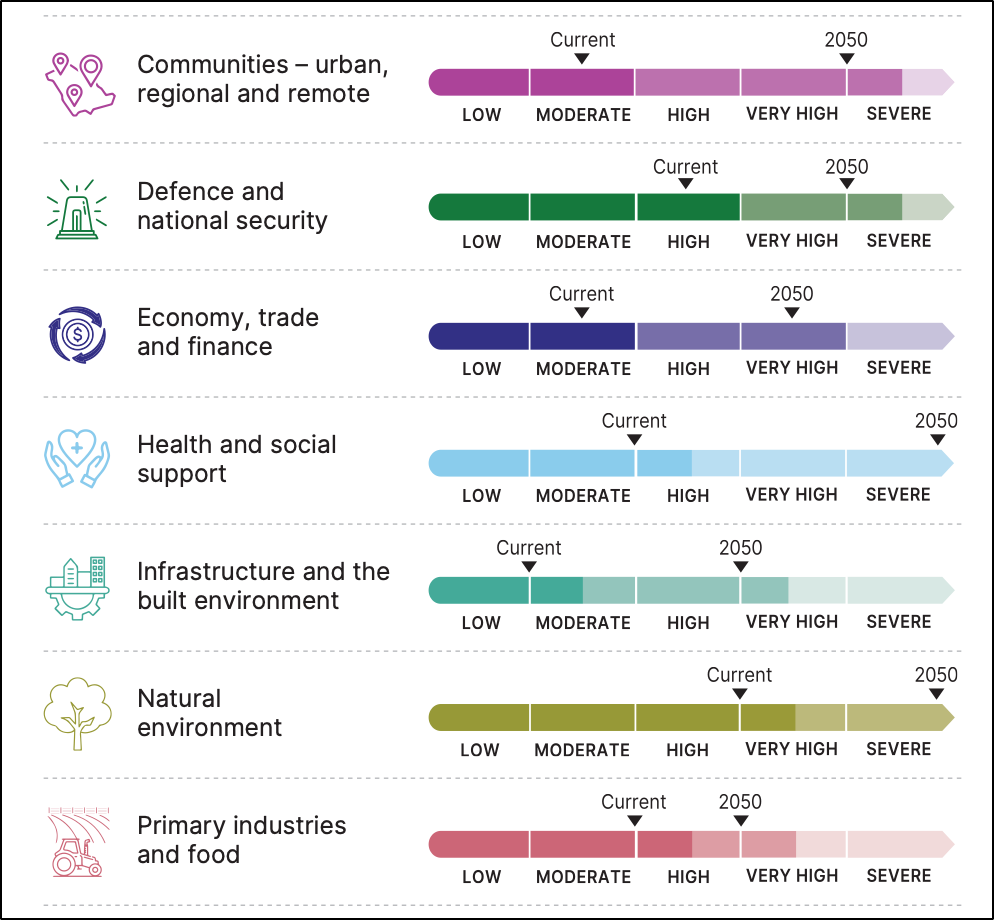
The level of risk was identified on a scale from low to severe, assessing both the current risk and expected risk by the mid-term time horizon of 2050.
The NCRA also looked at different global warming levels with temperature thresholds of +1.5°C, +2°C, and +3°C.
Figure 1 shows the systems most at risk:
- natural environment,
- defence and national security,
- health and social support, and
- primary industries and food are.
But note that by 2050, every system investigated is expected to be at high to severe risk.
Current emissions trajectories still put us on track for a +3°C rise in temperature. We are not doing enough, fast enough.
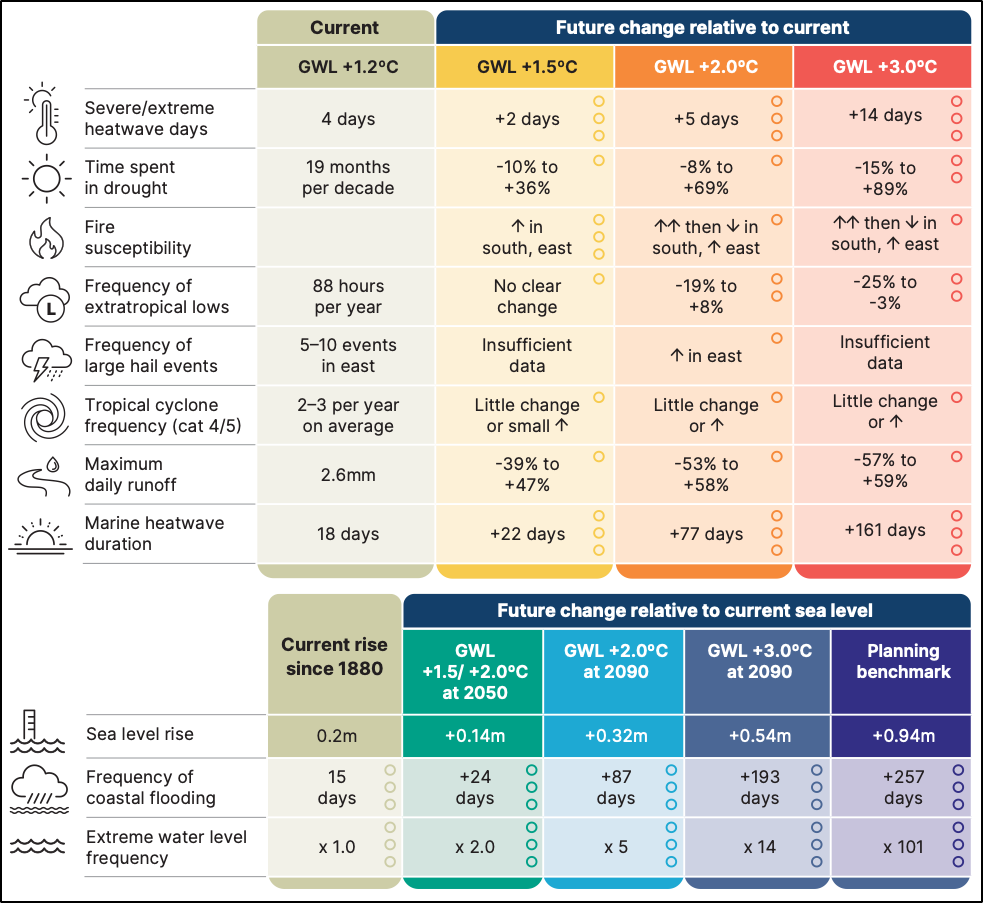
Figure 2 lists 11 climate hazards that will increase in severity, frequency, and/or duration under rising temperatures.
Here are just a few salient predictions for +3°C to send chills down your spine. And if not your spine, your kids’ spines, or their kids’. Your family, my family, your friends and neighbours. Enough to denial. We must act urgently.
Predictions:
- Extreme heatwave days – +14 days/yr
- Time spent in drought – up to 89% increase for some areas
- Marine heatwaves increase +161 days
- Frequency of coastal flooding +193 days
And these are with high data confidence levels. Pressure on farmers, business collapses, loss of the Great Barrier Reef, loss of marine species, thousands of houses flooded regularly and on and on and on.
By 2050.
No Con Job. Physics.
Just like other Physics in our lives – mobile phones, electricity, gravity, the orbits of planets. No belief required.
It is about science. Not about beliefs.
Whether you believe it or not is up to you. But the science is the science.
We need to get on with climate action.
In the waste/recycling sector that comes down to a few key actions that can reduce Australia’s emissions by 10% or 40mt CO2-e/year:
- Stop putting organics in landfill
- Capture the methane gas that landfills produce from old organics
- Drive up recycling to capture the embodied energy of materials (and thereby also reduce energy consumption by industry)
- Sequester carbon in soil via biochar and compost
- Use battery electric waste vehicles (the biggest truck fleet in the country)
- Generate renewable energy from waste (particularly the organic fractions)
Simple, do-able, cost effective.
Ours is the overlooked sector that can reduce emissions by 10%, tomorrow.
Mike Ritchie is the Managing Director and Mia Thompson is an Undergraduate Environmental Consultant at MRA Consulting Group.
This article has been published by the following media outlets: