NSW Landfill Cliff
By: Mike Ritchie, MRA Consulting Group

The NSW Environment Protection Authority has released the first chapter of its Waste and Circular Infrastructure Plan, acknowledging the scale of the problem and setting out solutions. But success depends on getting three policy levers right. And that means treating the landfill cliff not just as a crisis to manage, but as a driver for systemic reform.
The Crisis
Greater Sydney is facing an acute waste infrastructure shortfall (pictures speak a thousand words as they say). Currently, four landfills handle the region’s putrescible waste (the everyday household waste that fills red-lid kerbside bins). Due to scheduled closures, these landfills will lose capacity and, by 2030, face a shortfall of approximately 1.1 million tonnes per year. This gap will widen to 1.4 million tonnes per year by 2040 (Figure 1).
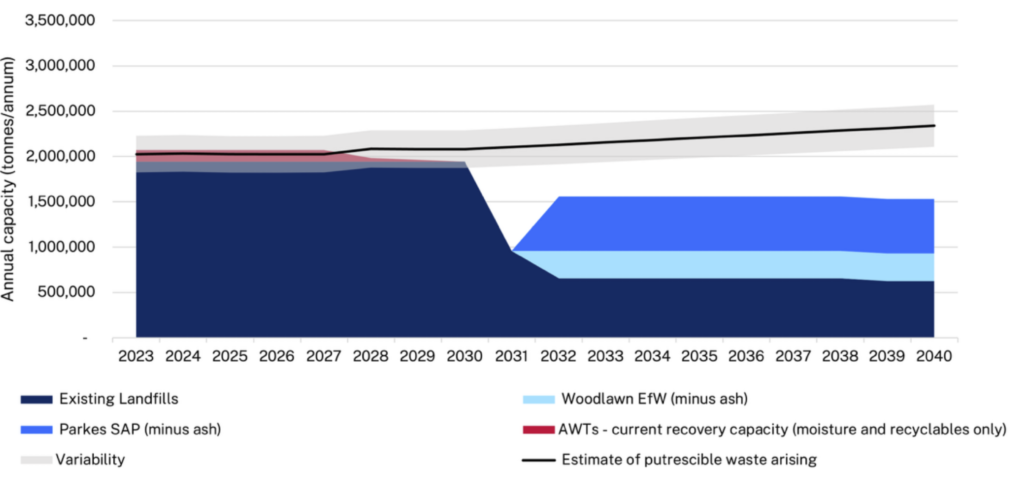
In practical terms, this means that from 2030, some of Greater Sydney’s waste will have no viable local disposal pathway. Households and businesses would face a 20% increase in red-bin collection fees. Construction and demolition activity could grind to a halt, disrupting critical infrastructure projects including housing development. According to the NSW EPA Plan, the economy could lose an estimated $23 billion, with 11,550 job losses and a 1.7% fall in average wage rates. People facing higher disposal costs may resort to stockpiling or illegally dumping waste, poisoning the environment and threatening public health.
The NSW Government, to its credit, has now acknowledged the problem. Minister for Environment Penny Sharpe and the Minns Government have accepted the reality of the landfill cliff and begun putting solutions in place, including the FOGO mandates to divert organic waste from landfill. This is a welcome shift from years of inaction; the industry has been calling for a proper infrastructure plan for over a decade.
The Plan’s Response
The Government’s approach is to enable a mix of solutions to address the void. These include:
- Streamlining planning approvals to fast-track extensions and expansions of existing landfills
- Considering reopening closed landfills where necessary to create additional capacity
- Enabling Energy from Waste (EfW) facilities where they can safely reduce reliance on landfill
- Improving waste infrastructure planning at a strategic, government-wide level
On the surface, this could read as an open slather on landfills. A swing from scarcity to excess. That must be avoided, because oversupply of landfill void space creates a new set of risks.
The Risk: A Race to the Bottom
If Government simply approves new landfill capacity without managing associated policy settings, competition for waste will intensify, gate fees will collapse, and recycling will lose its economic viability. Tonnes will inevitably chase cheap disposal. Recyclers relying on stable prices and minimum tonnages will see their business cases evaporate. The outcome would be a slide backward on recycling rates and a failure to meet the national target of 80% resource recovery by 2030.
To avoid this, Government must acknowledge a hard truth: even with aggressive recycling and the FOGO mandates, approximately 20–30% of waste is either impractical, impossible, or too costly to recycle. Government has a responsibility to ensure this residual material can be safely disposed of. But that responsibility does not mean opening the floodgates without guardrails.
Instead, Government must treat the landfill cliff as an opportunity for reform, a moment to reset the system so that recycling is protected and residual waste is managed responsibly.
Getting the Package Right
Three policy levers must work together to make this work:
1. Disposal availability (landfill void and/or EfW capacity)
Government must ensure sufficient safe disposal pathways for residual waste, avoiding both crisis (undersupply) and perverse incentives (oversupply). This requires careful strategic planning of landfill and EfW capacity, aligned with falling waste volumes as recycling improves. The risk is creating excess availability that destabilises the recycling market.
2. Landfill levy pricing
A robust landfill levy acts as an economic floor, protecting recycling by raising the cost of disposal and keeping gate fees above a critical threshold. Without a sufficient levy, competition for waste between disposal and recycling will drive prices down, and recycling businesses will lose viability. The levy must be set to account for genuine residual waste disposal needs, not to penalise landfill operators, but it must also keep disposal expensive enough that recycling remains the economically rational choice.
3. Resource recovery mandates and capacity
Regulatory mandates like the FO (food organics) and FOGO (food and garden organics) collection requirements establish a floor of protected tonnage for the composting and recovery sector. As these materials must be collected separately by 2030 (protecting up to 950,000 tonnes of household organic waste from landfill annually), the abundance or scarcity of landfill void does not undermine their market.
Done right, these three levers create a stable system: there is safe disposal for residual waste; recycling has protected economics; and waste reduction is incentivised at every level. Done wrong—for example, by approving new landfill void without adjusting the levy or strengthening mandates—the system collapses into disposal-chasing and recycling failure.
The Path Forward
The landfill cliff is not simply a short-term problem to be solved by approving more landfills. It is a structural challenge that demands a package of reform. The NSW Government has recognised the urgency and begun to act.
The next phase must be disciplined: Government must streamline planning for residual waste infrastructure while simultaneously strengthening the policy settings that protect recycling from the risk of cheap disposal. NSW currently landfills 7MT of waste. Easily half of that can still be recovered. That reduces the size, scale and urgency of the cliff
Additionally, the government must move on EPR for packaging, batteries, e-waste, furniture and the like. It must create the economic incentives for C&I waste sorting and recovery (especially cardboard, metals, plastic and timber) and it must continue to push the levy to create the economic conditions for the private sector to invest in C&D recovery.
NSW cannot credibly meet the national 80% recovery target by 2030 if the landfill cliff is managed in isolation. The cliff is a driver for change. Government must use it that way.
Mike Ritchie is the Managing Director at MRA Consulting Group.
This article has been published by the following media outlets: