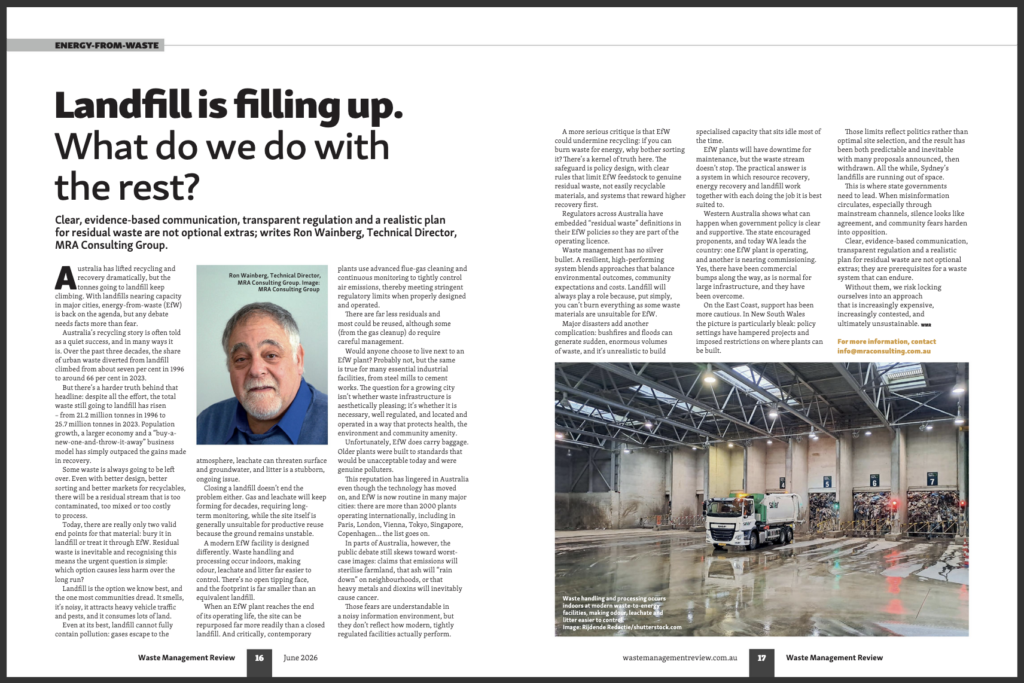
Landfill Is Filling Up. What Do We Do with the Rest?
By Ron Wainberg, Technical Director, MRA Consulting Group
With landfills nearing capacity in major cities, energy-from-waste (EfW) is back on the agenda, but any debate needs facts more than fear.
Australia’s recycling story is often told as a quiet success, and in many ways it is. Over the past three decades, the share of urban waste diverted from landfill climbed from about 7% in 1996 to around 66% in 2023. But there’s a harder truth behind that headline: despite all the effort, the total waste still going to landfill has risen, from 21.2 million tonnes in 1996 to 25.7 million tonnes in 2023. Population growth, a larger economy and a “buy-a-new-one-and-throw-it-away” business model have simply outpaced the gains made in recovery.
Some waste is always going to be left over. Even with better design, better sorting and better markets for recyclables, there will be a residual stream that is too contaminated, too mixed or too costly to process. Today, there are really only two valid end points for that material: bury it in landfill or treat it through EfW. Residual waste is inevitable and recognising this means the urgent question is simple: which option causes less harm over the long run?
Landfill is the option we know best, and the one most communities dread. It smells, it’s noisy, it attracts heavy vehicle traffic and pests, and it consumes lots of land. Even at its best, landfill cannot fully contain pollution: gases escape to the atmosphere, leachate can threaten surface and groundwater, and litter is a stubborn, ongoing issue. Closing a landfill doesn’t end the problem either. Gas and leachate will keep forming for decades, requiring long-term monitoring, while the site itself is generally unsuitable for productive reuse because the ground remains unstable.
A modern EfW facility is designed differently. Waste handling and processing occur indoors, making odour, leachate and litter far easier to control. There’s no open tipping face, and the footprint is far smaller than an equivalent landfill. When an EfW plant reaches the end of its operating life, the site can be repurposed far more readily than a closed landfill. And critically, contemporary plants use advanced flue-gas cleaning and continuous monitoring to tightly control air emissions, thereby meeting stringent regulatory limits when properly designed and operated. There are far less residuals and most could be reused, although some (from the gas cleanup) do require careful management.
Would anyone choose to live next to an EfW plant? Probably not, but the same is true for many essential industrial facilities, from steel mills to cement works.
The question for a growing city isn’t whether waste infrastructure is aesthetically pleasing; it’s whether it is necessary, well regulated, and located and operated in a way that protects health, the environment and community amenity.
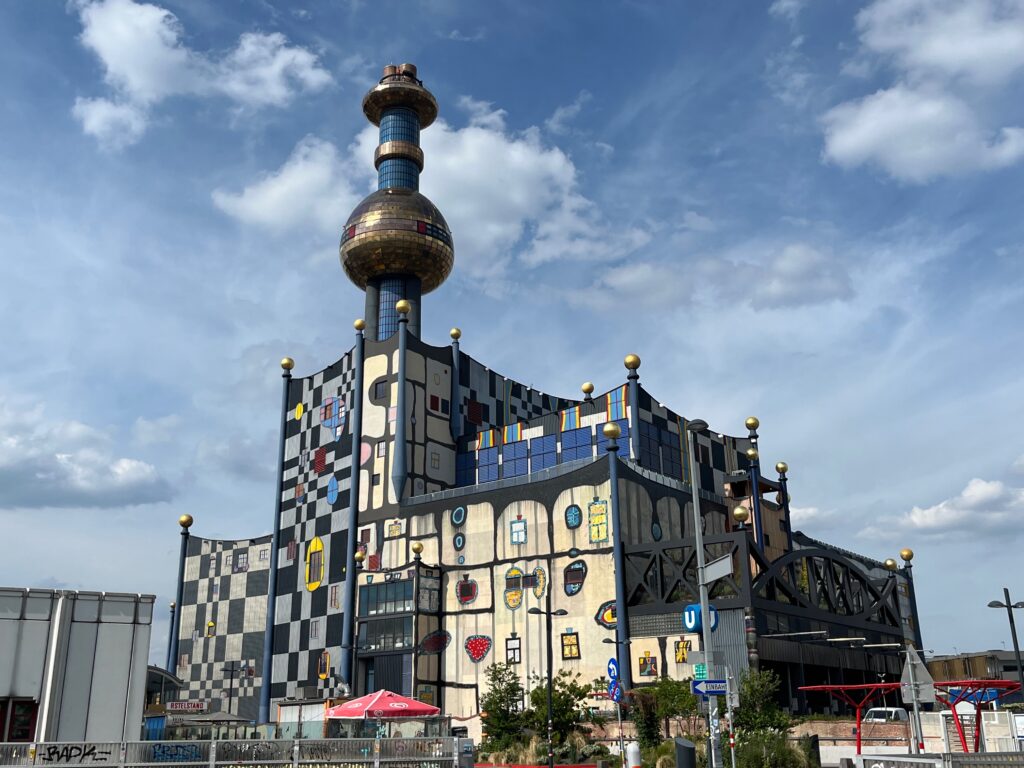
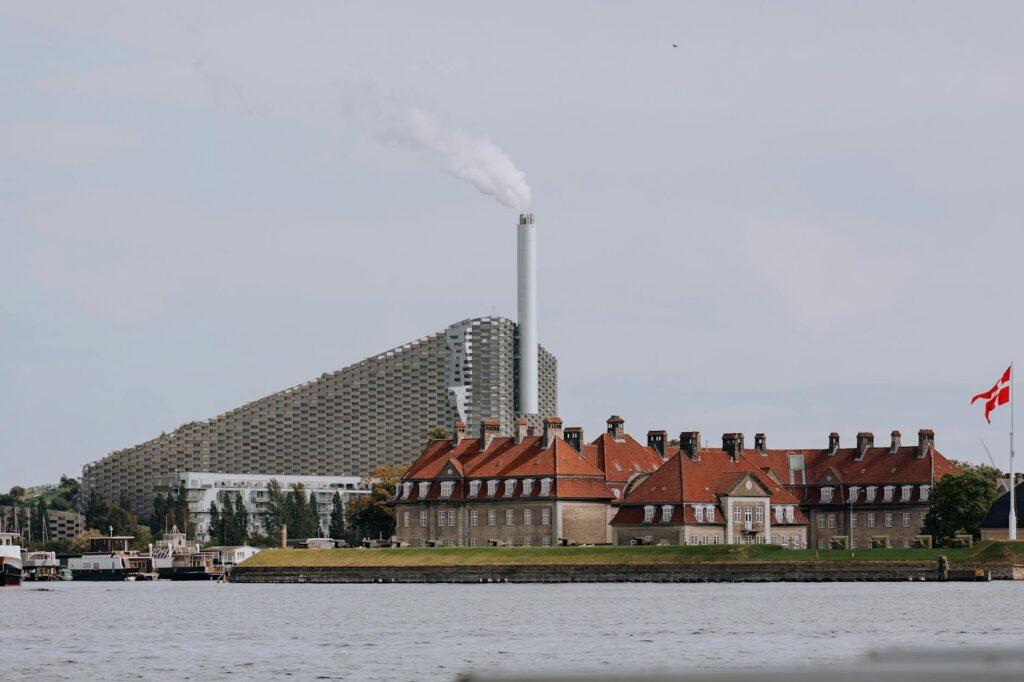
Unfortunately, EfW does carry baggage. Older plants were built to standards that would be unacceptable today and were genuine polluters. This reputation has lingered in Australia even though the technology has moved on, and EfW is now routine in many major cities: there are more than 2,000 plants operating internationally, including in Paris, London, Vienna, Tokyo, Singapore, Copenhagen…… the list goes on. In parts of Australia, however, the public debate still skews toward worst-case images: claims that emissions will sterilise farmland, that ash will “rain down” on neighbourhoods, or that heavy metals and dioxins will inevitably cause cancer. Those fears are understandable in a noisy information environment, but they don’t reflect how modern, tightly regulated facilities actually perform.
A more serious critique is that EfW could undermine recycling: if you can burn waste for energy, why bother sorting it? There’s a kernel of truth here. The safeguard is policy design, with clear rules that limit EfW feedstock to genuine residual waste, not easily recyclable materials, and systems that reward higher recovery first. Regulators across Australia have embedded “residual waste” definitions in their EfW policies so they are part of the operating licence.
Waste management has no silver bullet. A resilient, high-performing system blends approaches that balance environmental outcomes, community expectations and costs. Landfill will always play a role because, put simply, you can’t burn everything as some waste materials are unsuitable for EfW. Major disasters add another complication: bushfires and floods can generate sudden, enormous volumes of waste, and it’s unrealistic to build specialised capacity that sits idle most of the time. EfW plants will have down-time for maintenance, but the waste stream doesn’t stop. The practical answer is a system in which resource recovery, energy recovery and landfill work together with each doing the job it is best suited to.
Western Australia shows what can happen when government policy is clear and supportive. The state encouraged proponents, and today WA leads the country: one EfW plant is operating, and another is nearing commissioning. Yes, there have been commercial bumps along the way, as is normal for large infrastructure, and they have been overcome. On the east coast, support has been more cautious. In New South Wales the picture is particularly bleak: policy settings have hampered projects and imposed restrictions on where plants can be built. Those limits reflect politics rather than optimal site selection, and the result has been both predictable and inevitable with many proposals announced, then withdrawn. All the while, Sydney’s landfills are running out of space.
This is where State governments need to lead. When misinformation circulates, especially through mainstream channels, silence looks like agreement, and community fears harden into opposition. Clear, evidence-based communication, transparent regulation and a realistic plan for residual waste are not optional extras; they are prerequisites for a waste system that can endure. Without them, we risk locking ourselves into an approach that is increasingly expensive, increasingly contested, and ultimately unsustainable.
This article has been published by the following media outlets: