Why do we make household recycling so hard

By Mike Ritchie, Director, MRA Consulting Group
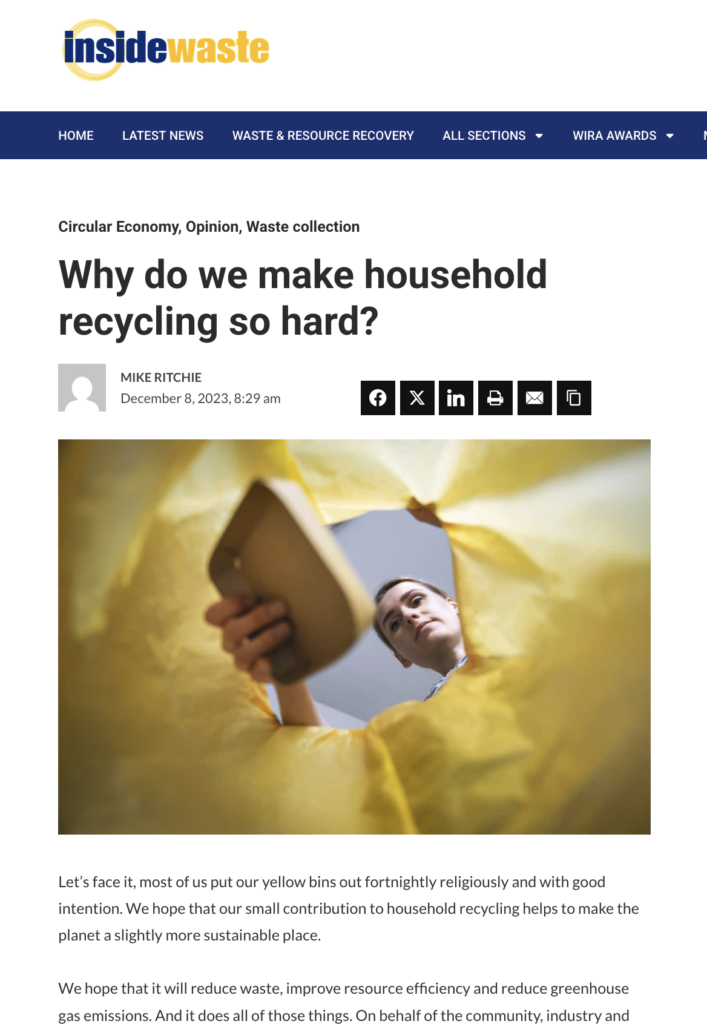
We hope that our small contribution helps to make the planet a slightly more sustainable place.
We hope that it will reduce waste, improve resource efficiency and reduce greenhouse gas emissions.
And it does all of those things.
On behalf of the community, industry and the planet, if you are one of those people, well done. Keep going.
Some of us however, use the yellow bin as just another way of getting rid of garbage. In fact, about 5% of us do that.
The only way to reduce that is to educate on the negative consequences, remove bins from problematic households or increase the capacity of the garbage bin (to reduce the need to use the yellow bin as a garbage bin).
Councils tend to operate in that order.
So how well do we do at education?
Pretty well overall.
For a system that provides no financial or other direct benefit to households we have over 95% participation in yellow bin recycling across Australia. Where councils offer the service, people use it.
By and large people feel good about recycling. They don’t need or want a direct financial benefit.
They want to know that their contribution is real and is not being taken for granted.
I have written previously that the best way to erode that contribution is for households to believe that their yellow bin recyclables are being sent to landfill.
I can with absolute certainty, guarantee that over 99% of the yellow bin material we put out for collection, ends up at a Material Recovery Facility (MRF) and is on its way to being recycled.
It is an absolute myth that large volumes of recyclables from yellow bins are sent to landfill.
Where do we need to improve kerbside recycling then?
Firstly, we need to get the 10% average contamination down. As I said about half of that figure is because some households use the yellow bin as a surrogate garbage bin. However, the other 5% comes from wish-cycling or error. We should be able to get that down to near zero by better education and importantly, simplification of the message.
Here is my key point.
The yellow bin system was set up to take paper/cardboard and glass, plastic, steel and aluminium containers. That is it.
Five simple products that people can recognise.
Originally the focus for plastic, glass and aluminium was drink containers, but that definition has evolved to now include other packaging items (of the same material stream).
Aseptic containers (liquid paper board – poppers and long life milk) were added by many Councils.
Steel aerosol cans were permitted by some Councils. However, many now refuse them due to the incidence and risk of fires.
Some allow more esoteric materials like plastic bags and coffee cups.
Most Councils now allow “rigid plastic packaging” in addition to the typical plastic drink containers. (Think strawberry punnet and biscuit trays). Some do not.
If we want to get wish-cycling and errors down, then we need to simplify and standardize.
How hard can it be?
The Federal Government has now agreed to a “national harmonization” project for Kerbside Recycling. Great start.
To my mind that is a no-brainer.
If we want to reduce wish-cycling and error then we need to make it simple. Get back to basics and educate.
Most MRFs were designed to take the 5 aforementioned materials (only) – glass, plastic, aluminium drink containers, plus paper/cardboard and steel cans.
There is, no doubt, a place for rigid plastic packaging.
But after that we need to have a national approach and preferably consistency. (Every time someone moves home, they are likely to bring their mind map of recyclables with them).
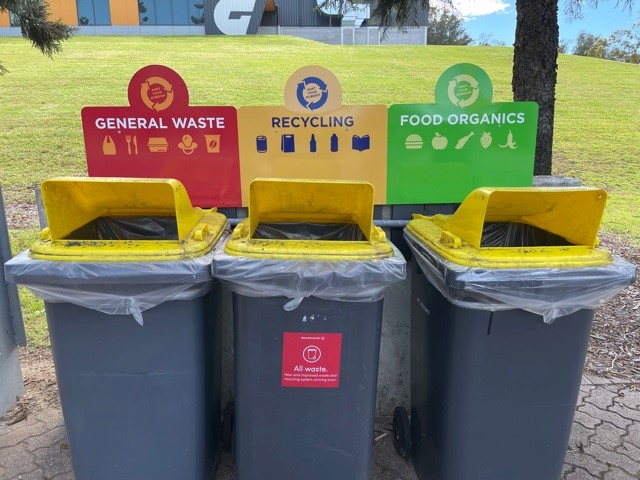
For example, adding soft plastic (in a special bag) is possible but only with national coordination and agreement.
What we actually need, is a minimum agreed list (as above) and then a national clearing house process.
By national clearing house process I mean a committee of experts representing local government (who pay for the lion’s share of recycling), MRF operators (who recover and sell it), packaging manufacturers and government.
We must not forget that what is allowed in a yellow bin is a function of a legal contract between a Council (procurer) and a MRF (service provider).
The packaging industry needs to have a seat at the table so they can be informed about what is, and is not, recyclable through a MRF. We need the ARL (Australian Recycling Label) to adequately reflect the realities of MRF recycling and Council contracts. Councils should not, must not, be considered a cash cow to take any old product that packaging manufacturers decide to put on the market. (There are any number of funky new products claiming to be recyclable through Kerbside recycling. Most are not.) (PS: there comes a point where we need to name and shame these products and their producers).That esteemed group should decide on the balance of aspiration, reality, cost and contamination, what should be allowed in, over and above the base model. Simple.
That is about it.
Mike Ritchie is the Managing Director at MRA Consulting Group.
This article has been published by the following media outlets: