The case for Packaging Reform in 2026
By: Will Rumsby and Mike Ritchie, MRA Consulting Group

In 2018, the Federal and State Governments announced the National Packaging Targets. We are now past the 2025 target date, how did we go?
The 2025 targets were:
- 100% of all Australia’s packaging will be reusable, recyclable or compostable
- 70% of Australia’s plastic packaging will be recycled or composted
- 50% average recycled content across all packaging
- Problematic and unnecessary single-use plastic packaging will be phased out
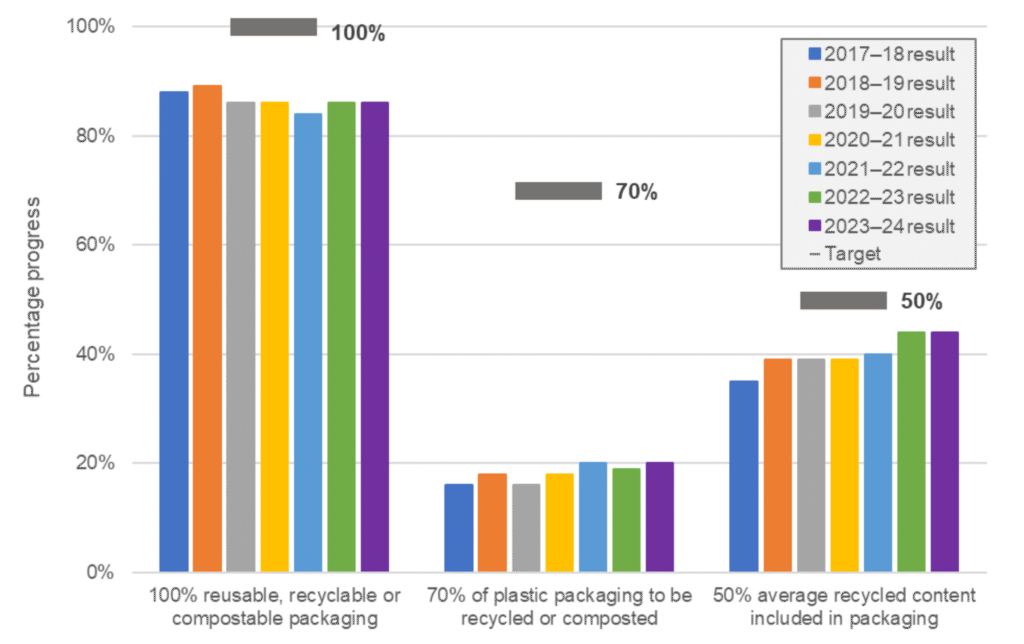
Although the latest available data is a year behind (from 2023-24), we look set to fail on all targets. There were discernible improvements in only one out of the three targets that are easy to quantify.
The table below shows the target and the current result as per APCO’s Australian Packaging Consumption and Recovery Data 2023-24 released in December 2025.
| Target | 2017-18 start | 2023-24 result |
|---|---|---|
| 1. 100% reusable, recyclable or compostable | 88% | 86% |
| 2. 70% plastic packaging recycled | 16% | 20% |
| 3. 50% recycled content | 35% | 44% |
In short:
- All packaging is now slightly less recyclable than it was seven years ago (88% to 86%);
- Plastic recycling has hardly shifted (from 16% to 20% with a goal of 70%); and
- Recycled content has increased from 35% to 44% but not achieved the 50% target.
As shown in Figure 1, not only have we failed to meet all targets, but we are also not making any noticeable year on year improvements (with the modest exception of recycled content).
Looking at individual materials, while the recovery rate of glass, metal and wood have improved noticeably and cardboard recovery slightly, plastic remains the recalcitrant problem that cannot be fixed under current arrangements (Figure 2).
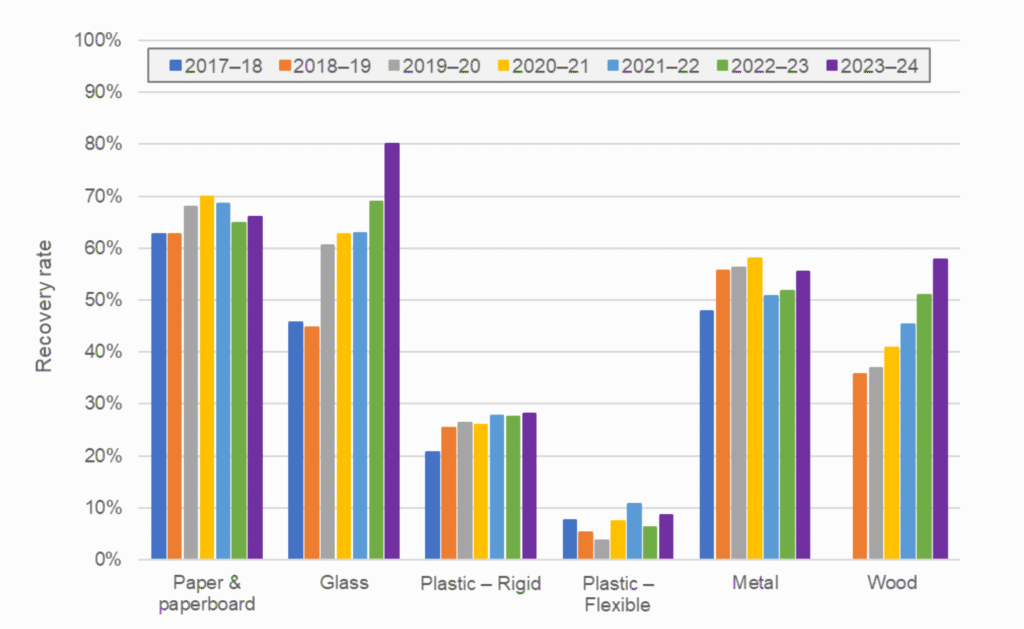
To put the plastic problem in context, it means that of the 1.3 million tonnes of plastic packaging generated in Australia each year, over 1 million tonnes still ends up landfilled or littered (compared to a target of only 300,000 t landfilled).
Most of us have recycling bins at home and kerbside recycling accepts many plastic types, so why are recycling rates so pathetic?
There are multiple reasons all of which point to the need for Government intervention:
- Landfilling plastic is economically rational (it is expensive to collect because it is low density, while is relatively cheap to landfill, compared to other materials, for the same reason);
- Plastic packaging is often complicated multi-polymer and multi-material composites making them difficult and expensive to separate and recycle;
- There are few reliable and high value markets for recycled plastic pellets or flake; and
- Plastic users can import recycled plastic pellets cheaper than buying domestic recycled pellets (virgin plastics are ridiculously cheap due to the glut in fossil fuels).
As a case in point, 99% of flexible plastic (think shrink wrap, pallet wrap and chip packets) is sourced from virgin oil or gas.
The solution is to bring the manufacturers, government and recyclers into a partnership based on mandatory Extended Producer Responsibility (EPR) arrangements. (And of course, eliminate unnecessary use of plastic).
All parties must focus on the complete supply chain to improve recovery, reprocessing and market availability.
The Australian Packaging Covenant Organisation (APCO; representing packaging manufacturers, importers and retailers) and the Australian Council of Recyclers (ACOR; representing the recycling sector) have both called for such a scheme to be established by the Federal Government.
It would work much the same way as the Container Deposit Schemes, now operating in every State. A mandatory levy is applied to all packaging to help support the recovery, recycling and market development of the packaging supply chain.
Modelling work done by MRA Consulting Group for APCO showed that a national scheme covering all packaging materials (including plastic and soft plastic) achieving a 70% recycling rate, would add between 0.5 and 1 cent to the cost of a product.
An ACOR and APCO report released today, estimated the cost to be 0.1% of the cost of sold packaged items.
Properly designed, such a scheme would “level the playing field”, ensuring that companies that have already committed to better packaging are recognised and supported, whilst the laggards are brought up to the same standard.
ACOR and APCO predict that over the next 5 years, such a scheme would:
- Increase economic activity in Australia by $2.5 billion in gross value-add;
- Spur additional investment of $220 million in private capital;
- Create almost 20,000 new jobs; and
- Reduce GHG emissions from plastic by 700,000 tonnes a year.
On the flip side, without a mandatory EPR scheme, ACOR and APCO have forecast that the use of plastic recycling facilities could fall to just 32% within 5 years, causing facility closures and job losses. Exactly the reverse of what we are hoping to achieve.
So where to next?
We need the Federal Government to turn its attention to a mandatory Packaging EPR scheme. In 2026. No delay.
This year must be the year of packaging reform.
Mike Ritchie is the Managing Director, and Will Rumsby is an Undergraduate Environmental Consultant at MRA Consulting Group.
This article has been published by the following media outlets: