What I learned about the State of Waste in Australia and NSW at Coffs 2026
By: Mike Ritchie, MRA Consulting Group
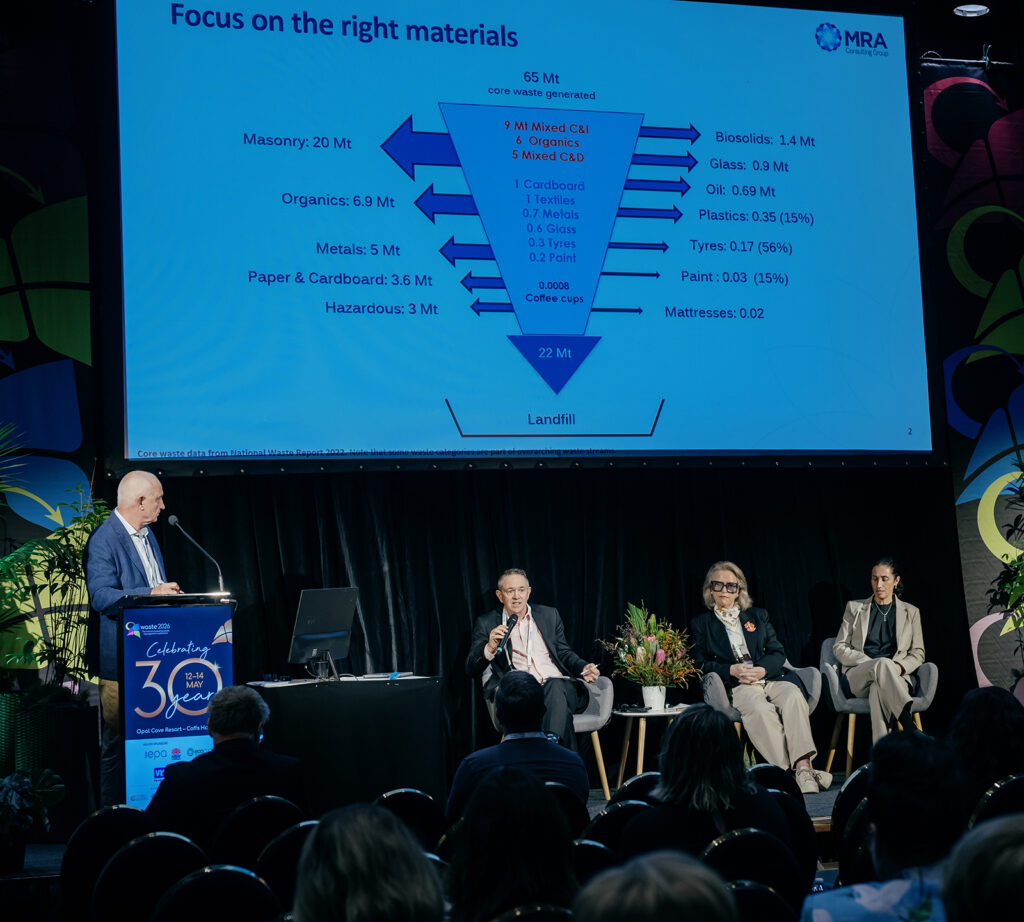
The conference reinforced that while there is innovation and commitment across industry and local government, the progress on the system-wide challenges facing waste management in general and NSW, in particular, has been limited.
There is no shortage of activity. Councils continue to advance projects, new technologies are entering the market, and private sector operators are actively pursuing solutions across multiple waste streams. These efforts are important and should be recognised. However, they are largely incremental. The structural settings required to deliver change at scale, remain unresolved.
This is reflected in the latest available NSW EPA waste data for 2023/24. While the lag in reporting is itself a challenge for effective policy response, the underlying trends are clear.
Waste generation continues to increase broadly in line with population and economic growth. Recycling performance has hit a wall, with only modest gains in recent years. Most notably, landfill disposal volumes remain persistently high, with no consistent downward trajectory over the past decade.
At a national level, there are important achievements worth acknowledging. As highlighted during the conference, Australia’s recycling rate has increased from approximately 7% in 1997 to around 64% today. This represents a significant structural shift and reflects the sustained contribution of the recycling industry. Importantly, this growth has absorbed much of the increase in waste associated with population growth and rising consumption.
However, even this progress has not translated into a reduction in landfill volumes. Nationally, waste to landfill has remained unchanged over two decades. We were landfilling 20MT in 1997 and are landfilling much the same now. This in spite of an 80% reduction in landfill target by 2030.
The National Waste Targets also set a 10% reduction in per capita waste generation by 2030. The data shows a 2.8% increase since 2020 (not a 10% decrease). Totally the wrong direction.
We need more structural reform now. Lets look at NSW as an example.
While NSW EPA engagement with the sector is welcome, the sector is looking for clear and decisive reform.
The Waste Levy Review is a key example. If we want infrastructure investment and jobs, we need market signals that work. Although understood to be complete, the Review has not yet been released. With a state election approaching, we must give the Minister breathing room, but we need levy reform delivered ahead of Council budgets ie April-May 2027.
Revisions to the Energy from Waste policy represent a positive step, particularly in improving clarity around emissions standards, recycling outcomes, and approval pathways. However, even under an efficient approval process, it is likely to be many years before new facilities are operational. In the meantime, landfill capacity constraints will continue to intensify.
This underscores the importance of getting the broader policy settings right. Particularly those that influence pricing signals and investment confidence. The Government is the only body that can pull the big levers of market pricing and regulation.
There are also targeted initiatives that should deliver benefits.
The introduction of a mandatory battery stewardship scheme in NSW is a practical and necessary measure, particularly given the growing risks associated with lithium-ion batteries in the waste stream.
Work underway on solar panel recycling (with QLD) is similarly constructive, though both initiatives represent relatively small contributions in tonnage terms.
Less clear is the pathway forward for Resource Recovery Orders and Exemptions following the Cathy Wilkinson review. Greater certainty in this area would support market development and reduce regulatory friction.
Levy hypothecation: the $2.7 billion question
The total Australian levy revenue per year is now approaching $2.7 Billion . A tiny fraction is being reinvested in recycling – its primary purpose.
The NSW waste levy will raise $971 million in 2025/26 according to Treasury.
The NSW Auditor General found only 13% of levy revenue was reinvested in waste-specific programs.
Waste Less, Recycle More invested $802 million over nine years (2012-2022), but that has been cut.
Industry bodies and local government representatives have repeatedly described the current arrangement as a “cash grab”, arguing that the levy functions more as a general revenue tool than a targeted instrument to drive circular economy outcomes.
This misalignment has real consequences. Councils and private operators face rising landfill costs but lack commensurate support for alternative infrastructure such as organics processing facilities, MRF upgrades, or market development for recycled products.
The result is a system where the levy penalises landfill disposal in theory but does little in practice to fund the alternatives needed to make that penalty meaningful.
FOGO and FO mandates: progress and limits
One of the more visible policy advances discussed at Coffs was the rollout of Food Organics and Garden Organics (FOGO) and Food Organics (FO) mandates. NSW has now legislated statewide FOGO collection for all households by 1 July 2030, with commercial and institutional FO separation required in stages from 1 July 2026 depending on residual bin volumes.
The intent is clear: divert almost 1 MT of organic material annually from landfill into compost and other circular products, while easing pressure on Greater Sydney’s landfills, which are projected to face capacity constraints by 2030. Large supermarkets will also be required to report food donations across key categories, linking waste diversion to food security objectives.
However, the mandate’s success hinges on factors beyond collection:
- Contamination: Early FOGO rollouts show that contamination rates can undermine the quality and marketability of end products.
- Economics of organics recycling: Compost and digestate markets remain underdeveloped in some regions, and without stable offtake agreements the financial viability of organics processing remains fragile.
Compulsory FOGO is therefore a necessary but insufficient lever. It creates a steady feedstock stream but does not, on its own, resolve the underlying economics or guarantee that diverted organics translate into high-value, low-emission outcomes.
Industry woes: a warning from the front line
The conference also highlighted the sector’s recent string of high‑profile failures and distress. While innovation is abundant, commercial profitability remains difficult in a market still shaped by underpriced landfill competition, weak end-markets for some recyclates, and variable regulation across jurisdictions.
Recent and notable cases include:
- REDcycle (2023): The national soft‑plastics program ceased operations in early 2023, leaving an estimated 12,000 tonnes of plastic stockpiled across multiple sites. These stockpiles have since been processed and recycled by IQ Renew, but the episode exposed the fragility of voluntary, retailer‑led schemes.
- Rino Recycling/ Queensland Recycling Technologies Group (2025): The Eagle Farm C&D recycling facility in which the Clean Energy Finance Corporation had invested millions, was placed into receivership in mid-2025. Its assets were sold to BMI Group in December 2025, with BMI indicating the site would enter a care and maintenance phase while it assessed the plant’s condition and environmental performance rather than immediately resuming full operations.
- Sircel (2025): One of Australia’s largest onshore e‑waste processors (e‑waste and solar recycling), Sircel entered voluntary administration and receivership in November 2025 following a secured creditor dispute and mounting financial pressures.
- Planet Ark Environmental Foundation (2025): The environmental not for profit behind several voluntary product stewardship schemes (including Cartridges 4 Planet Ark, Batteries 4 Planet Ark and Mobile Muster) entered voluntary administration in May 2025. Its board pointed to the lingering impact of COVID-19 on stakeholder support, the current economic climate and ongoing funding challenges, underscoring how even established, trusted brands in the circular economy space face financial strain.
- Goterra (2026): The Canberra based startup, which used black soldier fly larvae to convert food waste into feed and fertiliser, entered voluntary administration in June 2026 and was placed into liquidation in July after no viable buyer or recapitalisation offer emerged. Despite working technology and contracted customers (including Woolworths, the City of Sydney and Melbourne Airport), the business could not bridge the gap between revenue and the capital required to scale.
These cases share common themes: high capital intensity, exposure to commodity price volatility, and difficulty securing long-term, low-cost feedstock and stable offtake markets.
Industry data show insolvencies in the waste and recycling segment running at more than three times the national average, underscoring how even surviving businesses are navigating a difficult environment.
Local and national leadership
One of the more encouraging themes from Coffs was the continued leadership shown by local government. Councils are investing, trialling new approaches, and working closely with communities to improve outcomes. These efforts are essential. However, they cannot substitute for coherent, state-wide policy and funding frameworks.
But much more coordinated action by State and Federal Governments is needed to achieve structural reform and hit the 2030 Targets.
At the Federal level:
- Mandatory packaging reform
- Standardised kerbside collection system
- Mandatory EPR for a plethora of materials
- Standards reform especially AS4454 (the compost standard)
- Reform of the Export Bans
At the State level:
- Landfill levy reform
- Bans to landfill or collection mandates (e.g. FOGO and commercial FO)
- Minimum landfill standards
- End of waste codes
- RRO/E and its equivalents in each State
- Market development
- Education
In that context, Coffs 2026 can be seen as a reflection of a sector that is active, capable, and committed, but operating within constraints that limit its ability to deliver change at scale. Addressing those constraints will require coordinated action across policy, funding, and regulation.
The building blocks are well understood. The challenge is implementation.
If you need further information, please contact us at info@mraconsulting.com.au
Mike Ritchie is the Managing Director at MRA Consulting Group.
This article has been published by the following media outlets: